
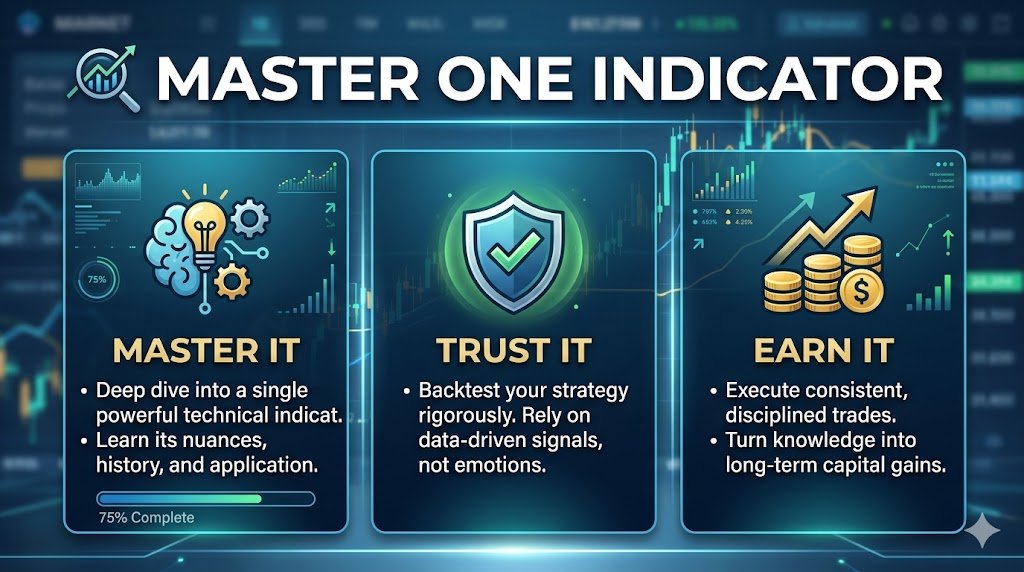
Why You Only Need One Indicator to Earn from the Stock Market?
Have you ever felt that earning money from the stock market is harder than it looks? Every day, thousands of people invest and trade using indicators — yet most of them end up losing money. The reason is not bad luck. The real reason is that they are using too many indicators at once and getting confused by all the signals.
Here is the truth — you do not need to master 10 indicators. You just need to master one. No indicator is 100% perfect, but if you understand even one indicator deeply and use it consistently, you can achieve up to 70% accuracy in your trades. And 70% accuracy is more than enough to earn consistently from the market.
In this blog, we will understand why less is more when it comes to indicators — and how sticking to just one can completely change your trading results.
Why Most Traders Fails?
Most traders fail not because the market is against them — but because of one simple mistake. They load their chart with 5, 6, even 10 indicators at once, hoping to catch every market move. But instead of clarity, they get confusion. Every indicator gives a different signal and the trader ends up paralyzed — unable to make a decision.
The bigger problem is what happens next. A trader starts with one indicator, builds a strategy around it, and feels confident. Then one bad day comes — their stop loss hits and they lose money. Immediately they think the indicator is wrong and start searching for a new one. They find a new indicator, build a new strategy — and the cycle repeats.
This is the loop that traps most retail traders. Constantly switching, constantly starting over, never mastering anything. And eventually — they quit the market completely.
The hard truth is — no indicator is 100% perfect. Not a single one. But that is not the problem. The problem is expecting perfection and giving up the moment it fails.
The One Indicator Mindset
“I fear not the man who has practiced 10,000 kicks once, but I fear the man who has practiced one kick 10,000 times.” — Bruce Lee
This quote was said about martial arts — but it fits the stock market perfectly. Most traders spend their time learning a little about everything and mastering nothing. The traders who generate consistent wealth are not the ones who know the most indicators. They are the ones who picked one, stayed with it, and practiced it for years.
Consistency and discipline are what separates a profitable trader from a losing one. And using just one indicator builds exactly that.
Benefits of Mastering One Indicator
- Catch the Real Move of the Market: When you deeply understand one indicator, you stop chasing every small market movement. You learn to identify the signals that actually matter — and that is when you start catching the big, profitable moves.
- Plan Better Entry and Exit: One of the biggest reasons traders lose money is poor entry and exit timing. When you master one indicator, you know exactly when to enter a trade and when to get out. No guessing, no hesitation — just a clear plan.
- Avoid Overtrading: Overtrading is one of the most common and costly mistakes in the market. When you rely on just one indicator, you naturally become more selective about your trades. You stop trading out of boredom or emotion and only trade when your indicator gives a clear signal.
How to mastery in one indicator
Knowing that one indicator is enough is only half the battle. The real question is — how do you actually build a working strategy around it? Here is a simple step-by-step approach that any beginner can follow.
Step 1 — Pick Your One Indicator
- Don’t pick randomly — try 2-3 on paper trading for 2-3 weeks
- See which one you understand most naturally
- Commit to it for minimum 3 months
Step 2 — Study It Deeply
- Learn every signal it gives
- Study it on different timeframes — 5 min, 15 min, daily
- See how it behaves in trending vs sideways market
Step 3 — Build Your Strategy Around It This is the most important step. Your strategy must answer 4 questions:
|
Question |
Example using RSI |
|
When to enter? |
When RSI crosses above 30 (oversold) |
|
When to exit with profit? |
When RSI reaches 70 (overbought) |
|
When to cut loss? |
When price breaks below support |
|
How much to risk? |
Never more than 2% of your capital per trade |
Step 4 — Test Before You Trade Real Money
- Practice on paper trading for at least 1 month
- Track every trade in a journal — entry, exit, result, reason
- Only move to real money when you see consistent results
Frequently Asked Questions
Which is the best indicator for beginners to start with?
There is no single “best” indicator — it depends on your trading style. However, RSI (Relative Strength Index) is highly recommended for beginners because it is simple to read and works well across most markets and timeframes.
How long does it take to master one indicator?
There is no fixed timeline, but if you practice consistently on paper trading, most traders start seeing patterns within 2–3 months. Give yourself at least 90 days before judging results.
What if my indicator keeps giving wrong signals?
No indicator is 100% accurate — that is completely normal. The goal is not perfection. If your system gives correct signals 60–70% of the time with proper risk management, you are already in a profitable position.
Can I use one indicator for both entry and exit?
Yes, absolutely. Most indicators like RSI or MACD give both entry and exit signals. Mastering one indicator means learning to read all its signals — not just the entry point.
Should I switch indicators if I am continuously losing money?
Not immediately. First ask yourself — are you following your strategy with discipline? Most losses happen not because the indicator is wrong but because traders deviate from their own plan. Give your strategy at least 20–30 trades before evaluating its performance.
Conclusion
Stop searching for the perfect indicator — it does not exist. Pick one, master it, and trust it consistently. There will be losing days, but with discipline and 70% accuracy, consistent profit is absolutely possible. The market rewards patience, not perfection.
Start today — pick one indicator and give it 30 days. That one decision can change everything.
Disclaimer
This blog is written purely for educational and informational purposes. The content shared here does not constitute financial advice, investment advice, or a recommendation to buy or sell any stock or financial instrument.
Stock market trading involves significant risk. Past performance of any indicator or strategy does not guarantee future results. Always do your own research and consult a certified financial advisor before making any investment decisions.
The author is not responsible for any financial losses incurred based on the information shared in this blog.