
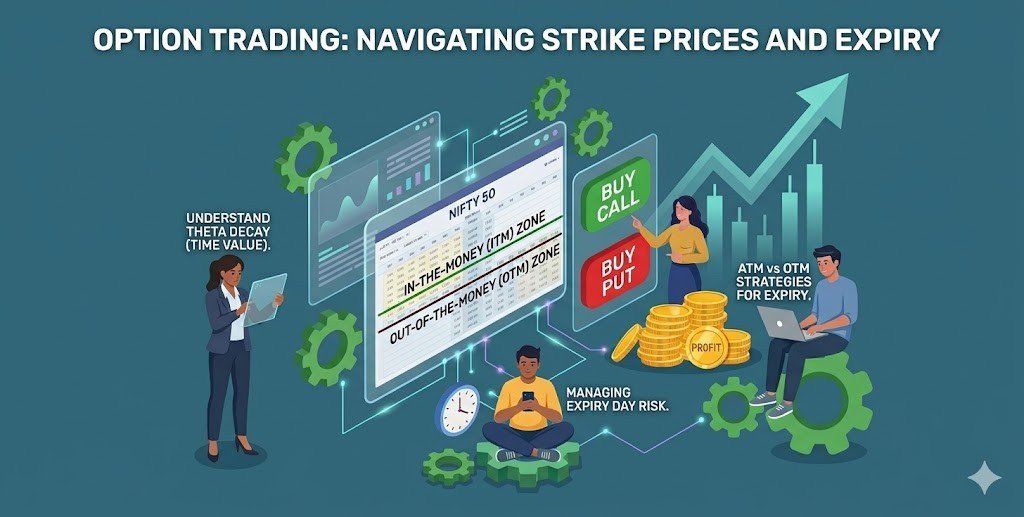
Which Strike Price Is Best for Option Buying on Expiry Day
Every week, thousands of traders lose money on expiry day — not because the market moved against them, but because they picked the wrong strike price. Choosing the right strike price for option buying on expiry day is arguably the single most important decision you make as an options trader. In this guide, you’ll learn exactly how to identify the best strike price, what separates winning trades from losing ones, and how to manage risk when every minute counts.
⚡Quick Answer : On expiry day, the ATM (At-The-Money) strike price is generally the best for option buying. It offers the highest liquidity, significant gamma exposure, and the best risk-reward balance. OTM strikes can deliver massive returns but carry extreme theta decay risk. Deep ITM options are safer but offer limited upside. The ideal choice depends on your directional conviction and risk appetite.
What Happens to Options on Expiry Day?
Expiry day is unlike any other trading session. The moment the clock starts ticking on expiry morning, the dynamics of options pricing shift dramatically. Time value — the portion of premium that exists purely because time remains — collapses at an accelerating rate.
This phenomenon is governed by Theta, one of the key options Greeks. On a normal trading day, theta might erode ₹2–5 of premium per hour. On expiry day, that erosion can be 5–10 times faster. For option buyers, this means you’re fighting against a ticking clock from the moment markets open.
Additionally, Gamma — the rate at which Delta changes — is at its peak on expiry day. This is a double-edged sword. A sharp, decisive move in the underlying can multiply your option’s value rapidly. But if the market stalls or chops sideways, your premium bleeds out faster than you can react.
Understanding this environment is non-negotiable before you even think about which strike price to choose.
Understanding Strike Price Types: ATM, OTM, and ITM
Before picking a strike price, you need to clearly understand what each category means in the context of expiry day option buying.
At-The-Money (ATM) Options
ATM options are those where the strike price is closest to the current market price of the underlying asset. If Nifty is at 22,350, the 22,350 CE or 22,350 PE is the ATM option. These options have the highest premium sensitivity and the highest liquidity on expiry day.
Out-of-The-Money (OTM) Options
OTM options are strikes that are beyond the current market price. For a Call option, any strike above the current market is OTM. These options are cheap to buy but have a low probability of expiring in profit. On expiry day, they are essentially lottery tickets — occasionally spectacular, usually worthless.
In-The-Money (ITM) Options
ITM options already have intrinsic value — the market has already moved in the option buyer’s favour. They are expensive but move more predictably with the underlying. On expiry day, deep ITM options behave almost like futures contracts.
📌 Expert Insight: In my experience working through hundreds of expiry day sessions, traders consistently overestimate OTM options and underestimate ATM ones. The lottery-ticket appeal of OTM options is psychologically powerful but statistically punishing.
Why Expiry Day Changes Everything for Option Buyers
Most option buying strategies that work mid-week simply don’t translate to expiry day. Here’s why.
On a normal trading day, you have the luxury of time. If the market moves against you initially, you can hold, wait, and let momentum build. Time value gives you a cushion. On expiry day, that cushion is gone.
The volatility crush is another critical factor. As expiry approaches, implied volatility (IV) typically drops sharply unless there’s a major unexpected event. This means even if the market moves in your direction, the compression in IV can offset your gains. Experienced option buyers know to factor this in before entering any position.
Finally, liquidity and bid-ask spreads widen significantly for far OTM strikes on expiry day. This makes entering and exiting positions costly, cutting into already thin margins.
Which Strike Price Is Best for Option Buying on Expiry Day?
This is the question every expiry day trader wants answered — and the honest answer is: it depends on your conviction and risk tolerance, but here’s a structured framework.
ATM Strike: The Balanced Choice
The ATM strike is the most sensible choice for most option buyers on expiry day. It offers:
- Maximum Gamma exposure — small moves create large P&L swings
- High liquidity — tight bid-ask spreads
- Moderate premium — not too expensive to risk, not too cheap to be meaningless
- Strong Delta sensitivity — reacts meaningfully to every price movement
If you have a clear directional bias (based on technical setup, news catalyst, or price action), buying the ATM Call or Put is your best vehicle on expiry day.
1. Strike OTM: The Calculated Risk
Buying one strike OTM (e.g., Nifty at 22,350, buying 22,400 CE) is a calculated risk that offers higher reward potential at a lower premium cost. This works when:
- There’s a strong breakout setup with volume confirmation
- The premium is still meaningful (not just ₹5–10)
- The expected move is significant (earnings event, macro data release)
Avoid going more than 1–2 strikes OTM on expiry day unless you’re treating it purely as a speculation bet with money you can afford to lose entirely.
2. Strikes OTM: High Risk, Lottery-Style
Anything beyond 2 strikes OTM on expiry day is statistically a poor trade for most setups. The probability of expiry in the money drops below 15–20% in most cases. These trades can produce 5x–10x returns, but the base rate of success is low. Position sizing must be extremely small if you go this route.
ITM Strike: The Conservative Entry
Buying ITM options on expiry day is suitable for traders who want directional exposure with lower theta risk. Since ITM options already have intrinsic value, theta impacts them less severely. However, the higher upfront premium means your capital at risk is larger, and the percentage return on investment is lower.
How Theta Decay Destroys OTM Option Buyers on Expiry
Let’s be specific. Theta — also called time decay — is not a gradual, linear process. It accelerates exponentially as expiry approaches. According to widely studied options pricing models, theta decay in the final hours of expiry day can account for 50–70% of the remaining time value in an option.
Here’s what this means practically:
- If you buy an OTM option at ₹30 at 9:30 AM on expiry day
- And the market moves sideways until 1:00 PM
- That option may be worth ₹8–12 by 1:00 PM — even without any adverse market move
This is the trap. Option buyers assume that a “flat” market is neutral for them. It isn’t. A flat market on expiry day is a slow, systematic destruction of OTM option premiums.
How to Protect Yourself from Theta on Expiry Day
- Trade with tight time stops — if your thesis doesn’t play out within 30–60 minutes, exit
- Avoid holding OTM options into the afternoon session unless a strong catalyst is pending
- Use smaller position sizes — because even correct directional calls can lose money due to theta
- Choose ATM or 1-strike OTM to retain meaningful gamma sensitivity without extreme theta bleed
What Is the Ideal Strategy for Expiry Day Option Buying?
The best expiry day option buying strategy combines three elements: the right strike price, a clear directional trigger, and strict time-based stop losses.
Step 1: Identify the Setup Before Market Opens
Before markets open on expiry day, do your analysis. Look at:
- Previous day’s closing price and key levels
- Global cues and overnight news
- Open Interest (OI) data — where is the maximum pain level?
- Support and resistance levels on the chart
Step 2: Wait for the First 15–30 Minutes
The first 15 minutes of expiry day are typically volatile and choppy. Premiums are elevated with high IV. Waiting for the initial noise to settle gives you a cleaner entry signal.
Step 3: Choose ATM or 1-Strike OTM Based on Momentum
Once direction becomes clearer — confirmed by a breakout, breakdown, or strong candle pattern — buy the ATM or 1-strike OTM option in the direction of the move. Don’t anticipate; react to confirmation.
Step 4: Set a Time Stop and Price Stop
Set a time stop: if the trade doesn’t work within 45–60 minutes, exit regardless of P&L. Set a price stop at 40–50% of the premium paid. These two rules alone will save you from the worst expiry day outcomes.
Step 5: Book Partial Profits Early
On expiry day, options can swing 50–100% in minutes. Book 50% of your position when you’re up meaningfully and let the rest ride. This locks in profit and reduces emotional decision-making under pressure.
Common Mistakes Option Buyers Make on Expiry Day
Even experienced traders repeat these errors on expiry day. Knowing them is half the battle.
- Buying too far OTM — chasing cheap premium without understanding probability
- No time stop loss — holding positions all day hoping for a reversal
- Overtrading — taking multiple positions to recover losses, compounding the damage
- Ignoring IV crush — buying options just before a scheduled event and being caught in volatility collapse afterward
- Wrong strike for the expected move — buying a strike that requires a 200-point move when the average expiry day range is 80–100 points
FAQ — Option Buying on Expiry Day
⚡ OTM = cheap but risky
👉 Choose OTM only during breakout setups.
Conclusion
Choosing the right strike price for option buying on expiry day is not guesswork — it’s a disciplined process built on understanding theta, gamma, market structure, and your own risk tolerance. The ATM strike remains the best default choice for most traders because it balances liquidity, sensitivity, and cost. OTM strikes can reward you massively, but only when paired with strong directional setups and extremely tight risk management.
The best expiry day option buyers aren’t the ones who find “cheap” strikes. They’re the ones who understand what each strike price actually represents and match it to a clear, time-bound market thesis. Start with ATM, respect theta, use time stops, and always size your positions conservatively on expiry day.
⚠️ Disclaimer: Options trading involves substantial financial risk and is not suitable for all investors. This blog is for educational purposes only and does not constitute financial advice. Always consult a SEBI-registered investment advisor before making trading decisions.